
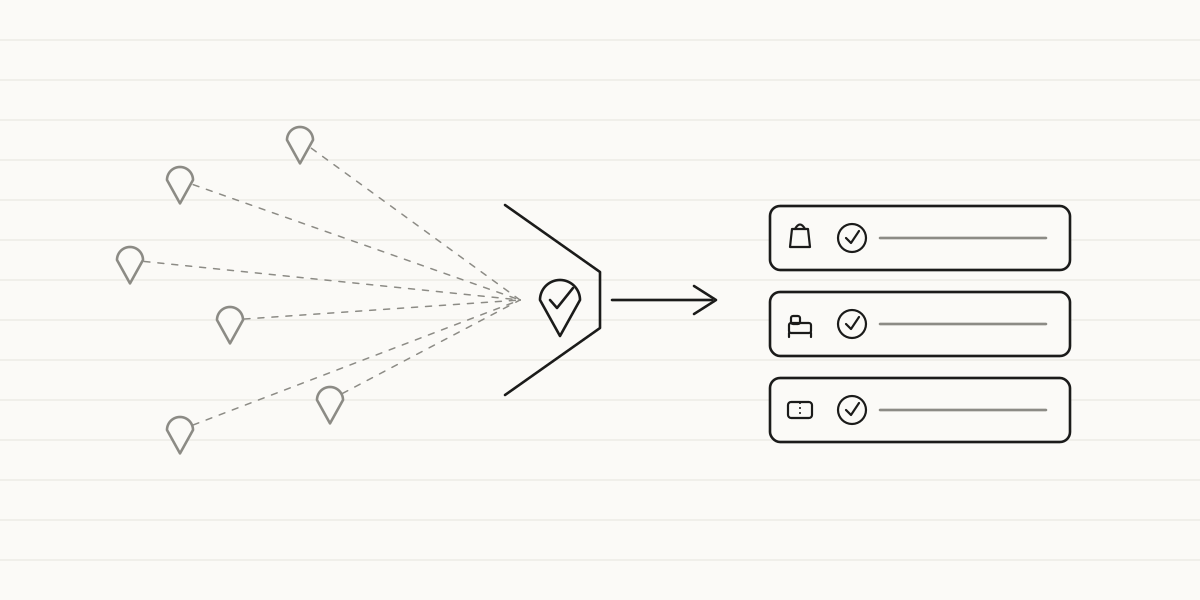
Since August 2026, Ask Maps, Google Maps' AI assistant, can order food delivery on a user's behalf and compare hotel prices and availability in real time, according to Google's official announcement. For now it only works in the United States, but it points the way: AI no longer just recommends businesses, it is starting to close the sale too.
Until now, when someone searched for a restaurant or a hotel on Google Maps, the AI gave a recommendation and the work of ordering, calling, or filling in a form was still theirs to do. With Ask Maps, that last step starts to disappear: the user asks it to "get me my usual dinner" or "find me a hotel with a free room this weekend", and the assistant compares options, picks one and, in the case of food, places the order without anyone picking up a phone.
What has changed in Google Maps
According to Google's official announcement of August 6, 2026, Ask Maps adds three new capabilities. Food delivery orders, through partner platforms such as Square and Toast, with Uber Eats announced for later. Hotels: the assistant compares price and availability in real time and links through to the provider's site to complete the booking. And events: it shows nearby concerts and shows with links to buy tickets.
Google is also adding two less flashy but equally important pieces: personalised answers using information from Gmail — off by default, you have to turn them on — and memory of previous conversations, so the assistant picks up where you left off without you repeating yourself. According to TechCrunch, the launch reflects Google's ambitions "to transform Google Maps from a navigation tool into an assistant".
What agentic AI means for a small business, no jargon
Until now, AI in search did one job: recommend. It told you which restaurant, hotel or shop matched what you were after, and then it was up to you to call, visit the website or fill in a form. An AI agent takes it one step further: besides recommending, it acts. It compares prices, checks availability and, if it has permission, places the order or the booking without the user ever landing on your website or picking up the phone to you.
For your business the difference runs deeper than it looks. When AI only recommended, you still had the final say: the customer landed on your website or called you, and that was your moment to sell, to answer questions, to offer something extra. Once AI also executes the order or the booking, that conversation disappears. The sale gets decided by whatever information the agent finds about you at that exact moment: if it's complete and accurate, you win the customer without lifting a finger; if it's missing or wrong, you lose them without ever knowing they existed.
Why this won't stay in the United States
It's true that Ask Maps' food ordering and hotel and event discovery only work in the United States for now: Google says they will reach more countries "over time", without giving a date. Don't read that as "this doesn't concern me yet": read it as "this hasn't arrived yet, but the pattern is already in motion". It's not just Google: the general-purpose assistants your customers already use, like ChatGPT or Perplexity, have been adding features to complete tasks, not just answer questions. The destination is the same, even if everyone's timeline is different.
And here it's worth being honest about the starting point. According to the Survey on ICT and e-commerce use in businesses published by Spain's National Statistics Institute (INE) on October 22, 2026, with data for the first quarter of 2026, 33.6 % of Spanish companies with 10 or more employees use artificial intelligence, and that share drops to 21.4 % for those with fewer than 10. And it's not just AI: 82.9 % of companies with 10 or more employees have a website, but among those with fewer than 10 the figure falls to 36.2 %. When this reaches Spain, a large share of its SMBs will be arriving late twice over: without a website in good shape, and without having touched AI yet.
What your business needs so an AI agent can choose you without friction
You don't need new technology to get started: you need the information you already have to be complete, accurate, and sitting where an agent looks for it. Three concrete things.
Your Google Business Profile, complete and without gaps. Name, address, phone, category, real opening hours — holiday and seasonal hours, not just the usual ones — and, if it applies, your menu or catalogue. It's the first place an agent checks before deciding whether to recommend you or rule you out.
Availability and prices always up to date. An agent comparing options in real time doesn't wait around: if your hours say open and you're not, or your listed price doesn't match the real one, it simply picks the competitor whose information checks out. It's the same logic we covered in how to get ChatGPT to recommend your business: AI rewards consistency, not marketing budget.
The ordering or booking platform you already use, connected. If you take orders by phone, through your own app or a booking system, that system needs to be able to talk to whatever these assistants check. That's exactly the job of a custom integration: not switching tools, but making the one you already have visible and actionable from the outside.
Which sectors will feel it first
Food orders will be felt first by restaurants and hospitality: we covered that in detail in AI for restaurants: 5 processes you can automate this month. Close behind comes accommodation, where comparing price and availability in real time is exactly what the assistant already does. But the pattern doesn't stop there: any business that lives off someone booking an appointment or a slot — a clinic, an academy, an estate agency showing a flat — enters the same playing field as soon as an agent can check real availability and close the booking. In how your local estate agency can compete with proptech we already told that same race from another angle.
How Zen Praxis can help
At Zen Praxis we work right on that frontier: we make your business's availability, prices and bookings visible and actionable from the outside, and we set up AI-powered service that answers and handles those requests in your tone, without depending on someone being awake to catch them. We always start the same way: a free assessment to see where your information stands today and what's missing for an AI agent to act on it, a proposal with a fixed budget, implementation on top of what you already use, and support afterward. The first solution can be up and running within weeks.
When a customer asks their assistant to order dinner or find them an appointment, a table or a room, the question isn't whether it's going to happen, but whether your business will be among the options that assistant finds in good shape. Book a free 30-minute call and we'll go through whether your information is ready for AI to work in your favour, no jargon and no strings attached.