
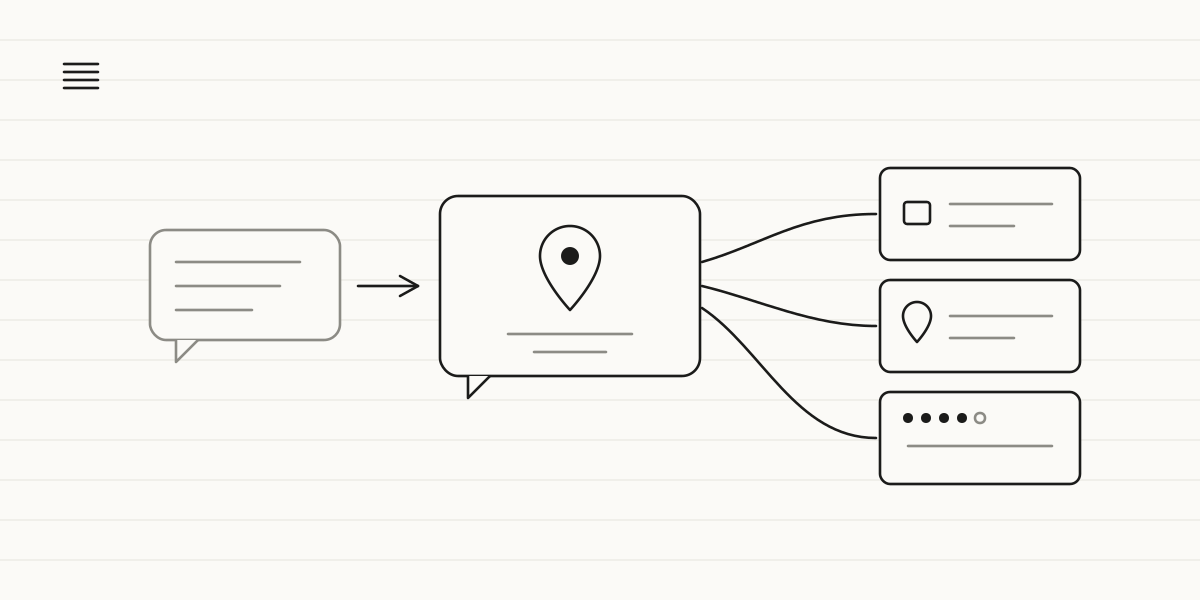
For ChatGPT to recommend your business you need three things: a clear website that says what you do, who for and where; the same details everywhere (Google listing, directories and social profiles); and content that answers the questions your customers actually ask, in their own words. Assistants cite businesses whose information is consistent and verifiable: you can't pay to appear.
Two years ago, someone looking for an accountant, a physio or a place for the company dinner opened Google and looked at the first results. Today, more and more people open ChatGPT and type the question exactly as they'd say it out loud. And what they get back isn't a list of ten links: it's two or three names. Either you're among those names, or you don't exist in that conversation.
Your customers no longer start their search on Google
This isn't a hunch. An analysis by Fattory and BeConfluence covering more than 160 million data points puts at 66 % the share of Spanish consumers who already use AI to research products and brands before buying. AECOC gets to a similar figure by another route: two in three consumers use ChatGPT when shopping. And among younger people, 62 % say they trust the products AI recommends to them.
The part that affects you most was quantified by Similarweb, and it's worth reading slowly: when ChatGPT mentions a brand, the odds of the user ending up on that brand's website multiply by 2.5. But most people don't click inside the chat. What they do is note the name and search for it on Google afterwards.
That detail explains why almost no small business has noticed yet: in your analytics, that visit shows up as someone searching for your name on Google. It looks like brand traffic; it was really a recommendation from a chat. And it works in reverse too: if the assistant doesn't mention you and mentions the business next door instead, nothing looks odd in your metrics. That call simply never comes in. It's the same underlying shift we cover in why AI matters so much for your business right now, only arriving through your customers' door.
How an AI assistant "decides" which business to recommend
There's no ranking here like Google's, and no algorithm you can climb with tricks. An assistant builds its answer by pulling together whatever it finds published about you —your website, your Google listing, industry directories, reviews, press mentions, what other people say— and it keeps what it can verify in more than one place. Put shortly: AI recommends what it understands and can check.
Which gives you the rule that governs everything else: consistency counts for more than volume. If your website says you open on Saturdays and your Google listing says you don't, if there are two different phone numbers depending on where you look, or if the service you actually live off isn't written down anywhere, the assistant doesn't invent an answer: it recommends the competitor whose information raises no doubts. It isn't a penalty — it just had nothing solid to say about you.
| What the assistant looks at | Where it lives in your business | What usually goes wrong |
|---|---|---|
| What you do and who for | Your website (home and service pages) | Empty brand copy that never names the service |
| Where you are and when you open | Google listing and directories | Different hours and phone numbers in each place |
| Whether others speak well of you | Reviews and mentions | Old reviews, none of them answered |
| Whether you answer what's asked | FAQs and blog articles | Generic content, no sector and no location |
| Whether your data is machine-readable | Schema markup on your website | It doesn't exist: nobody asked for it |
And now the good news, which hardly anyone mentions: AI assistants have no paid positions. There's no equivalent of the Google ad. That levels the field in a way it hasn't been for years: a small business with its information in order can win the recommendation over a big brand with a far bigger budget, because what decides it isn't how much you spend but how clear and consistent your information is. The honest flip side is that there are no guarantees or shortcuts either: nobody can sell you "appearing in ChatGPT", just as nobody can sell you the top spot on Google.
Five steps to get AI to find you and cite you
This has a technical name —AEO or GEO, optimisation for answer and generative engines— and a simple translation: putting your information where AI reads it, in the form it understands. These are the five steps, in the order I'd do them if you opened the business tomorrow.
1. Make your website answer questions, not just describe services. Most small business websites read like a brochure: "end-to-end solutions", "a personal touch", "over 20 years of experience". An assistant can't recommend that to anyone. Put on the site the questions you get on the phone every week —how much it costs, how long it takes, whether you take emergencies, whether you handle my particular case— and answer them in the same language people use to ask. If you don't know what they are, you already have them: they're the ones that keep repeating in your inbox, the ones listed in how an AI chatbot answers 90 % of your inquiries.
2. The same details everywhere. Exact name, address, phone, opening hours and list of services: identical on your website, your Google listing, your industry directories and your social profiles. It's the least glamorous task on the list and the one that pays off most, because it's exactly what AI checks. Give it an afternoon, make a list of everywhere you're published and fix it all in one go. The bigger version of this idea —one good version of every piece of data— is from scattered spreadsheets to clear decisions.
3. Fresh reviews, answered. Reviews are the source an assistant leans on most to decide whether you're a safe recommendation, and it values two things that cost nothing: that they're recent and that the business replies. A steady flow —always asking, at the same point in the process— is worth more than a spike of twenty reviews in one month followed by two years of silence.
4. Useful content about your sector and your area. This is where you beat the chains, because nobody can write about your city and your speciality with your judgement. An article that properly explains a specific problem your customers have in your area is citable material; a "it's Christmas already" post isn't. The sector examples we publish follow that line: restaurants, clinics or accounting firms.
5. Structured data on your website. It's the only item on the list you can't do yourself, and it's solved with one sentence: ask whoever handles your website to add schema markup for local business, services and frequently asked questions. They're tags invisible to visitors that tell a machine "this is an opening time", "this is an address", "this is a question and its answer". It's cheap, it's done once, and it turns your site into something AI can read without guessing.
The two-minute test
Before changing anything, measure where you stand. Open ChatGPT —and if you can, repeat it in Gemini and Perplexity— and ask the way a customer would: "best [your sector] in [your city]", and then something more specific: "which [your sector] would you recommend in [your area] for [your customer's typical problem]?". Write down which businesses come up and, above all, which sources the answer cites.
You come up: check that what it says about you is correct —hours, services, area— and look at where it got that from. Those sources are the ones to look after. Your competitor comes up and you don't: open the pages it cites and check where they're published and you aren't; there's your to-do list for next week. Nobody comes up, or the answer is generic: that's the best possible news, because it means AI has no local material to cite in your sector and area, and the spot is free for whoever takes it first.
Repeat the test once a month with the same questions and log the result. There's no rank-tracking tool like in classic SEO, so that rough notebook is the best measurement available today.
Where to start without being a tech company
Of the five steps, three are yours and you can start them this week without spending a euro: the real questions on your website, identical details everywhere, and reviews kept up to date. The other two —content with judgement behind it and a website machines can read— are the ones that usually sit on the pending list for years, and they're exactly the ones that make the difference when someone asks about a business like yours.
That's part of what we do at Zen Praxis: a free diagnosis to see what information you have published and what AI is saying about your business today, and from there whatever it takes —sorting out the data, bringing the website and the content up to standard, or building the assistant that answers those same questions on your own site—. With fixed timelines and budget, the first solution running in weeks and the potential to free up to 35 hours a month per person, with the investment recovered in under six months.
Do the two-minute test before you read anything else. If you don't like the result, book a free 30-minute call and we'll tell you what's missing for AI to be able to recommend you, no jargon and no strings attached.