
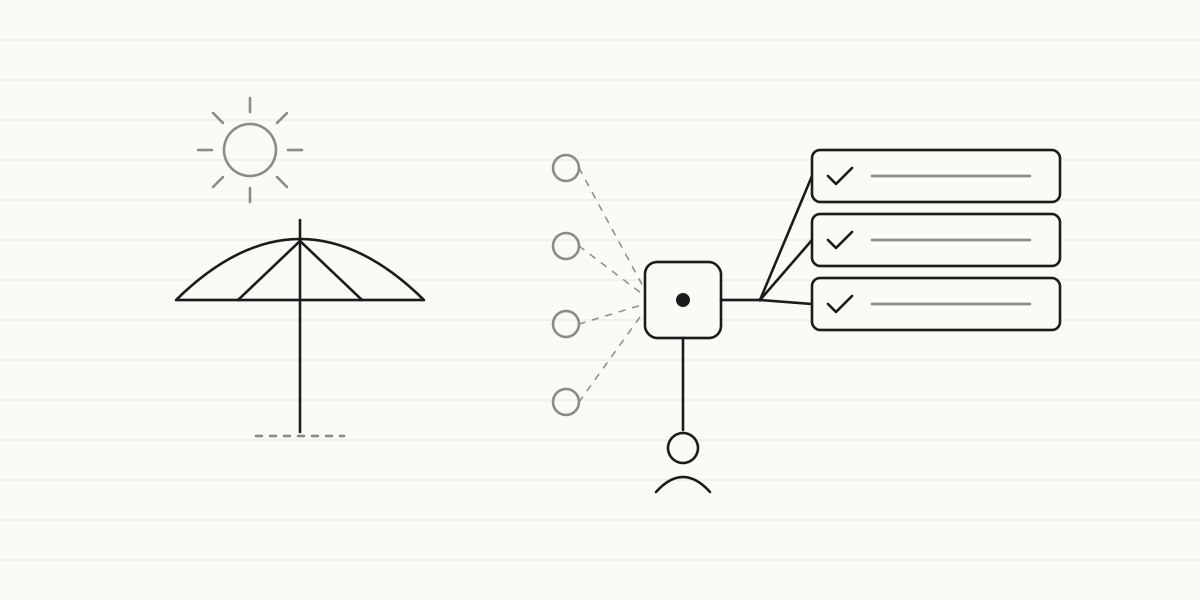
You can go on holiday without leaving your customers unattended by combining three automations: a chatbot that answers the usual inquiries 24/7 in your brand's tone, useful automatic replies in email and WhatsApp, and online bookings or appointments that confirm and remind on their own. That way, most of August's inquiries get resolved without you having to step in.
August has a trap for the owner of a small business: you want to switch off, but the business keeps taking calls, messages and bookings like any other month. And because everything runs through you, the only way you know to leave with peace of mind is not to fully leave. This article is about breaking that false choice — close entirely or stay on call — with tools that are within your reach today.
The number that hurts: one in four won't rest this year
According to the July 2026 survey by Spain's National Federation of Self-Employed Workers' Associations (ATA), 23 % of the self-employed won't take a single day of holiday this year, and 34.4 % will keep working through July and August. But what really matters isn't the how much, it's the why: the number-one reason, for 41.3 %, is that there's nobody who can run the business in their absence.
The problem, then, isn't the work itself: it's the dependency. And even those who do get away carry it with them — 63.1 % of the ones who leave admit they don't switch off, answering WhatsApps from the beach towel and checking email before falling asleep. The real goal isn't "to close down properly in August". It's for the business to stop needing you to be watching your phone.
What AI can handle for you in August (and what it can't)
The good news is that almost everything that ties you down in summer is repetitive, and the repetitive can be left resolved. These are the three pieces that take off the most weight, plus what's better left alone.
Repetitive inquiries: hours, prices, deadlines, "are you open?". Most of what comes in by phone or message is the same twenty questions as always, and every one of them interrupts someone. A chatbot well trained on your business's information answers the bulk of those inquiries at any hour, in your brand's tone, and only logs for you the ones that genuinely need a person. We look at it in detail in how an AI chatbot answers 90 % of your inquiries.
Bookings and appointments: requested, confirmed and reminded on their own. Restaurants, clinics and academies live off the calendar, and August is when it's easiest for a booking to fall through because of a forgotten note. An online system takes the request, confirms it and sends an automatic reminder — which also cuts down no-shows. One figure helps size it up: according to TheFork, every empty table from a phantom booking is about €78 on average that isn't recovered. You'll find the guides by sector in AI for restaurants and AI for clinics.
Email and WhatsApp: automatic replies that genuinely help. The difference is between a "we're closed until September, thanks" —which frustrates— and a reply that resolves: August hours, how to book or buy without you, who to turn to if it's urgent, and capturing the contact for September along the way. The first one loses the customer; the second serves them better than if you'd answered yourself at eleven at night.
What NOT to automate. A complex quote, a delicate incident or an angry customer aren't jobs for an automatic reply. But that doesn't mean they have to interrupt your time at the pool: the AI collects them, sorts them and leaves them ready for your return —or for a colleague on call—, with the context already gathered. Automating isn't disappearing: it's filtering out what genuinely needs you.
The 5-step plan to leave the business "on autopilot"
You don't need a technology project to leave more calmly. In this order you reach August with the essentials covered:
1. Take stock of the typical inquiries. Write down the ten questions customers ask you most. It's the raw material for everything else: without them no chatbot or auto-reply is any good.
2. Write the answers. Draft them once, properly and in your tone: that same text serves both the chatbot and the automatic reply, even if you set nothing else up this summer. It's the start-with-the-concrete approach we describe in 5 tasks you can automate with AI this week.
3. Turn on the chatbot or, at a minimum, useful automatic replies in email and WhatsApp Business. The basics work from day one.
4. Define how urgencies get escalated. A single channel through which a real urgency —and only a real urgency— reaches a person on call. Everything else, filtered.
5. Check ten minutes a day, not three hours. Instead of being on alert the whole time, a daily glance at what got logged. The difference between a holiday and an undercover on-call shift is right here.
What if I'm out of time for this August?
It depends on how far you want to go. The basics —useful automatic replies and online bookings with confirmation and reminder— can be switched on in days, so the last two weeks of July still make it for this summer. A first complete solution, with an AI that answers in your business's tone, is built in weeks: ready for the autumn peaks. And the goal isn't only this August — it's that the next time you close the door, the business keeps serving without you. In the cases we work on, that kind of automation frees up to 35 hours a month per person, with the investment recovered in under six months.
A real example of the business not depending on you
At Odonis, coordination between the dental clinic and the lab keeps running without anyone having to stay glued to the phone: the prescription is sent structured and the status of the work is visible in real time. Nobody calls to ask "how's my order coming along?" or waits around for an answer. It's the same idea applied to a specific sector: leaving a business on autopilot isn't closing it down — it's having the usual inquiries answer themselves and only the exceptions reach a person.
Want to head off in August with the business covered? Book a free 30-minute call and we'll tell you what to automate first in your case, no jargon. Tell us how you work and we'll point out the clearest opportunities for your business, no strings attached.