
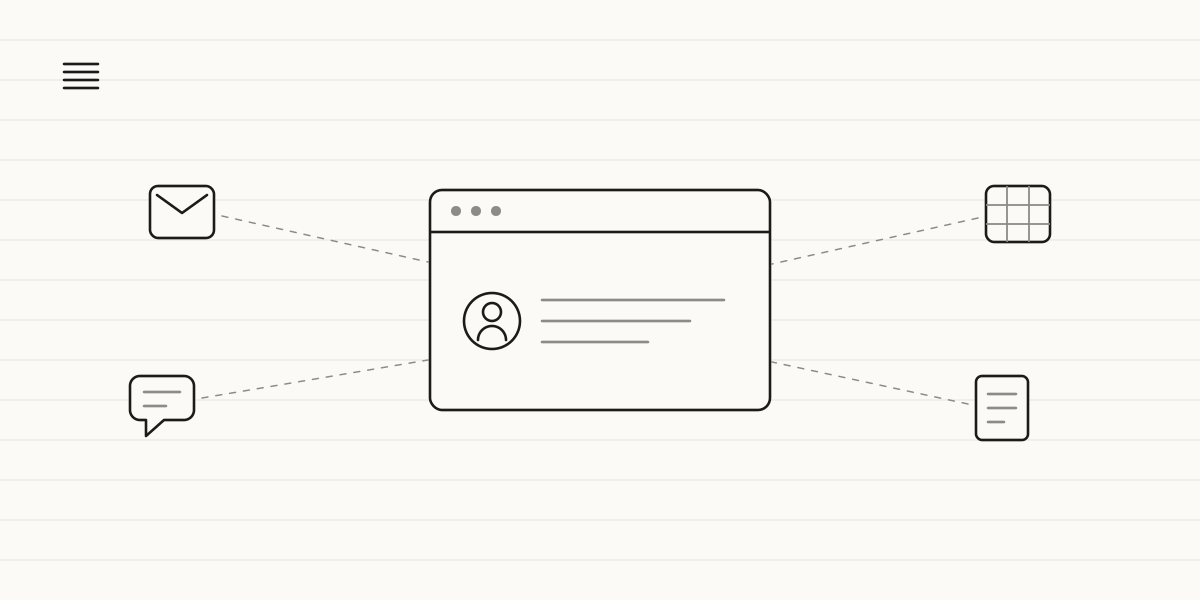
Corporate amnesia is a business's inability to remember previous interactions with its customers, who are forced to repeat their information at every contact. The cure is connecting the channels and programs you already use —email, WhatsApp, CRM, invoicing— so that anyone on the team, or an AI assistant, has the full history instantly.
A customer from three years ago calls and asks for the usual. Whoever picks up asks for their name, what they ordered last time and what went wrong. The customer explains it again, with slightly less patience than before. It isn't bad service or a lack of care: that customer's information is scattered across an inbox, a WhatsApp thread, a spreadsheet and the head of a colleague who is away this month. The business didn't forget them out of carelessness. It forgot them because there was never anywhere to remember.
What corporate amnesia is
The term has taken off on the back of Twilio's State of Customer Engagement Report, and it describes something instantly recognisable: a company accumulates interactions with a customer for years and can't retrieve a single one at the moment it's needed. Every contact starts from zero. For the customer, the feeling is exact and damaging: nobody here knows who I am.
The same report lands two figures that have to be read together: 83 % of executives believe they know their customers well, but only 45 % of customers agree. That gap of nearly forty points isn't a perception problem. It's the distance between what the company has stored and what it manages to retrieve when the phone rings.
How it shows up in your day to day
In a small business corporate amnesia never appears in a report: it appears in specific scenes. The customer writes on WhatsApp and you have to ask their name. They call and whoever answers doesn't know they sent a complaint by email yesterday. They ask for the quote you sent in May and it turns out it's in the inbox of someone who's off until September. Someone notes something in a spreadsheet that a colleague had already noted in another one.
One symptom sums up all the others, and you can spot it this week with no tools at all: how many times a customer starts a sentence with "as I already told you". Every one of those sentences is the business forgetting something the customer does remember. And in August, with half the team away and answers depending on who happens to be in, the number spikes —the same underlying problem we cover in how to serve your customers while you're away.
What it's costing you
The cost isn't cosmetic. According to Twilio, 71 % of consumers would abandon a purchase after an experience "without context" — that is, after having to repeat their case on every channel. Seven out of ten. They don't complain, they don't ask for the manager and they don't tell you why: they simply stop replying and buy somewhere else. It's the worst kind of loss, the one that leaves no trace in any metric.
And it isn't only outward-facing. HubSpot's data for Spain points the same way inside the company: 41 % of businesses admit that the lack of shared information between departments hurts their results. In a ten-person company "departments" simply means that whoever sells and whoever supports don't see the same thing — with the added twist that in a small business the same person always pays for each repetition: the one rebuilding the customer's story by hand while the customer waits.
Why it happens: the data exists, but it isn't connected
Here's the counterintuitive part. Almost no business has a shortage of data: it has all of it, and has had for years. You know what that customer bought, what they asked, what you invoiced them and what went wrong with the October delivery. The problem is that each of those things lives somewhere different, and none of those places talks to the others. Information isn't missing. Connections are.
| Where the information lives today | What gets lost on the way | What changes once it's connected |
|---|---|---|
| One person's inbox | The quote you sent exists only in their mailbox | Anyone on the team sees the latest quote and its status |
| The company WhatsApp | Conversations nobody logs or links to the customer | The thread stays attached to that customer's record |
| A shared spreadsheet | Different versions and data untouched since March | One good record, updated from wherever the work happens |
| The invoicing software | Who bought what never reaches whoever answers | Whoever replies knows what they bought, when and for how much |
| Someone's head | It leaves with that person: holiday, sick leave or a new job | The knowledge stays in the business, not in one person |
HubSpot measures the consequence too: 76 % of service teams receive incomplete information from sales. Translated to a small business, that's the colleague handling a complaint without knowing what the customer was promised when they bought. It's the same problem we covered in from scattered spreadsheets to clear decisions, seen from the other side of the counter: there, scattered data stopped you deciding; here, it stops you helping the customer in front of you.
The cure: connect what you already use (without changing tools)
The usual reaction is to assume you need a new system: a new CRM, migrate everything, train the team all over again. It's almost never the answer, and it's exactly why the problem goes unsolved for years — the project is so big the right moment never comes. The alternative is a custom integration: leave every tool where it is and make them pass information to each other. Your team keeps working with what it knows; what changes is that whatever gets written in one place now shows up in the other.
1. A single customer record
This is the centrepiece: one view holding everything that customer has done with you, whichever tool you open it from. Their details, their orders, their invoices, the emails they've sent, the WhatsApp thread, the October complaint and the quote still waiting to be signed. It isn't a new database: it's what you already have, gathered in one place and updating itself.
What changes: whoever picks up the phone starts the conversation knowing who they're talking to and what happened last time. "Let me check and call you back" and "a colleague handles that" both disappear. It's also what makes everything else possible: without a single record, neither AI nor anyone else can remember anything.
2. Support with a memory
An AI assistant connected to that record stops being a generic question-answering machine and becomes something that recognises the customer. It knows who's writing, what they bought, where their order is and what they asked last time, and it answers with that context at any hour. When a query has nuance, it hands it to a person with the history already on screen, without making the customer repeat anything. That's the difference between a chatbot and an assistant: a well-built AI chatbot answers 90 % of your inquiries, but it only answers well the ones it can answer with real data.
One important nuance: the memory has to be useful and visible, not invasive. Remembering the previous order is service; surfacing data the customer doesn't recall giving you is discomfort. The practical rule is to use only what the customer would assume you already know.
3. Personalisation that sells
This is the part that isn't defensive but offensive. 88 % of consumers would be more likely to buy if they get personalised service in real time, but only 44 % of organisations currently have the technology to deliver it, according to Twilio's figures. That distance between what people want and what companies offer is literally a competitive advantage waiting for someone to take it.
And here a small business starts with an advantage it hardly ever uses: it has fewer tools and fewer places to connect than a large company. A ten-person business with a unified history can deliver more personal service today than a competitor with twenty systems and three departments that don't talk to each other. Personalisation stopped being a question of size; it's a question of having the information connected.
Where to start this week: three steps
1. Draw the map. On a sheet of paper, write down where any given customer's information lives today: email, WhatsApp, the invoicing software, the calendar, two spreadsheets and someone's head. It usually comes out at five or six places, and there's almost always one you weren't expecting. That map is all the diagnosis you need to start.
2. Connect just two. Don't try to join everything at once: pick the two tools the team uses most —usually the channel customers come in through and the place where purchases get recorded— and make them share data. A small project that works beats a big one that never starts, which is exactly the logic behind the 5 tasks you can automate this week.
3. Measure one single thing: how many times this week a customer has had to repeat something they'd already told you. Put a mark on paper each time it happens. That number is your thermometer, and it's the only indicator you'll need to know whether this is working. When it drops, you'll notice it in sales before you notice it in any report.
That's how we work at Zen Praxis: a free diagnosis to see where your customer information is scattered today, a proposal with fixed timelines and budget, and implementation on top of the tools you already use — without stopping the business or making anyone learn a new program. The first solution can be running in weeks, with the potential to free up to 35 hours a month per person and the investment recovered in under six months.
How many times has one of your customers had to repeat themselves this week? If the answer makes you hesitate, book a free 30-minute call and we'll tell you what to connect first, no jargon and no strings attached.