
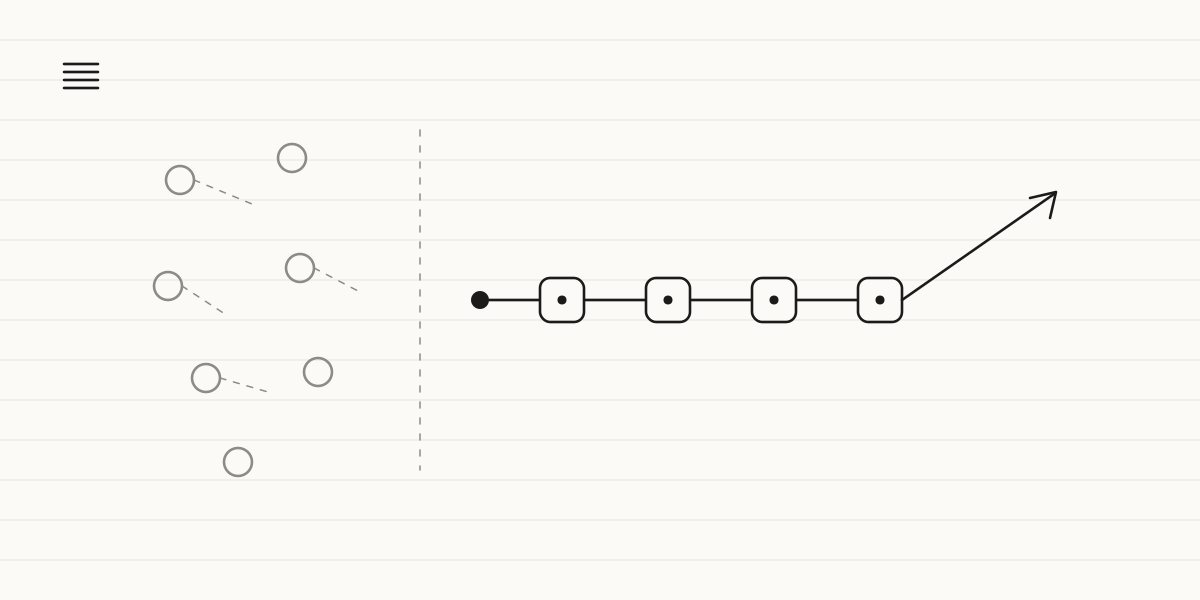
According to a study by SAS and IDC (2026), almost 70 % of SMBs are stuck at the experimenting stage with AI and only 9 % have it integrated into their operations. Going from testing to results takes four steps: a diagnosis of your processes, one concrete use case with a fixed budget, implementation, and support for the team.
The scene probably sounds familiar: someone on the team uses ChatGPT "for some things", last year you tried a chatbot nobody touches any more and, if someone asked you how many hours AI is saving you, you wouldn't know what to answer. It isn't a problem with you or your team: it's the majority pattern. And the way out isn't trying more tools.
Using AI isn't the same as getting value from it
It was carried out by IDC —International Data Corporation, one of the big international technology market-research firms— and commissioned by SAS, surveying more than 1,600 SMB executives across 28 countries. The picture that comes out is very recognisable: 37 % run isolated experiments with AI, 33 % have started structuring initiatives but without ever scaling them, and only 9 % have it integrated into their day-to-day decisions and operations.
| AI adoption stage | SMBs |
|---|---|
| Isolated experiments, no plan behind them | 37 % |
| Structured initiatives, but no scale | 33 % |
| AI integrated into decisions and operations | 9 % |
A line from IDC sums it up well: "Experimenting with the technology is easy; using it strategically and sustainably is much harder". And it isn't an isolated figure. Spain's first DES 2026 barometer points the same way: 87.2 % of companies say they already use AI agents, but only 8.5 % have them deployed across the whole organisation. Almost everyone has started; almost nobody has finished.
So it's worth pinning down what "integrated" means, because that's where everything is decided: AI is integrated when a complete process runs on it every day and somebody measures the hours it gives back. If either half is missing —the whole process, or the measurement— what you have is a test, however well it works on the day you demo it.
The five reasons your business stays stuck in pilots
The study identifies five barriers, and in a small business they translate into something far more concrete than "lack of strategy". These are they.
1. Nobody decided which problem to solve. It almost always starts with the tool rather than the problem: someone reads about an AI, tries it and then goes looking for something to use it on. The question that puts everything else in order isn't "what can I do with AI?", it's "which task is eating the most hours this month?". Without that answer, every test is entertaining and none of them pays off. It's the underlying idea in why AI matters so much for your business right now: it isn't about technology, it's about hours.
2. Your data lives in ten different places. An AI answers with the information you give it, and in most small businesses that information is spread across the invoicing software, three spreadsheets, the inbox and the heads of two people. That's why pilots impress in the demo and disappoint in real life: it isn't that the AI is bad, it's that it has no access to what you know. Sorting that out is half the work, and we cover it in from scattered spreadsheets to clear decisions.
3. Everyone uses their own AI on their own. With no approved route, people solve things with whatever personal account is at hand. It's called shadow AI and it has two effects: it exposes data that shouldn't leave the company, and it stops knowledge from accumulating anywhere —whatever each person learns stays in their browser—. We go into it in your team is already using AI and you probably don't know it.
4. You don't measure what it saves you. This is the quietest barrier. If nobody wrote down how long it took before, nobody can say how long it takes now, and an initiative that can't prove its value is the first one cut when budgets tighten. One figure is enough: minutes per time multiplied by times per month. You don't need a dashboard.
5. Experiments never become processes. This is the last stretch, and where most fall. A test that works doesn't turn itself into the normal way of working: someone has to own it, how it's done has to be written down, and the team has to know how to use it without asking. If the automation depends on one specific person being there, you don't have a process, you have a favour.
How you get from testing to results: the method in four steps
The difference between the 70 % that experiments and the 9 % that gets value is almost never budget or size. It's the order. This is the one we follow in the Zen Praxis Method, and it works the same in a six-person firm as in a workshop.
Step 1: a diagnosis of your processes. Before touching any tool, look at where the hours go: what repeats, how many times a month and who does it. Out of that comes a short list of candidates and, above all, the "before" picture you'll measure against later. It's free and it's the step that saves the most pilots.
Step 2: one concrete use case, with fixed timelines and budget. One, not five. The most repetitive and measurable on the list. Closing the scope, the deadline and the price before starting is what turns an open-ended trial into a project with an ending: you know what you'll have, when and for how much.
Step 3: implementation end to end. Automate the whole process, not the flashiest half. A flow that resolves 80 % and leaves the remaining 20 % undefined forces someone to watch over it, and that supervision eats the saving. And it goes in with the business running: nothing has to shut down and nobody has to stop.
Step 4: support and training for the team. So people use it without depending on anyone, with someone inside the company owning it and the hours saved reviewed at the three-month mark. This is where a test finally becomes the normal way of working.
In that order, the first solution can be up and running in weeks. The potential of this kind of automation is freeing up to 35 hours a month per person on repetitive tasks, with the investment recovered in under six months. And, what matters more in the medium term: the second process always costs less than the first, because the data is already sorted and the team already trained.
Where to start this week
You don't have to wait for a digital transformation plan to take the first step. Three low-risk things are enough to get out of the experiment phase.
First, spend three days writing down the tasks you repeat: replies to customers, appointment reminders, moving data from one program to another. Second, pick the one that comes up most and put a number on it —minutes per time × times per week— that figure is your starting point and your future proof that it worked. And third, start with the obvious and reversible: the tasks in 5 tasks your SMB can automate with AI this week or, if what mostly comes in is the same twenty questions as always, an assistant that answers 90 % of your inquiries.
What gets measured improves. What doesn't stays an eternal pilot.
If you're not sure which that first process is in your case, book a free 30-minute call: tell us how you work and we'll point out the clearest automation opportunities for your business, no jargon and no strings attached.