
Custom software is no longer just for large companies. With AI-assisted development —what's known as vibe coding— a small business can have its own tool running in weeks and at SMB cost, because the line item that always blew up the budget, programming hours, has dropped dramatically.
Almost every small business we know lives with the same scene. There's a management program that was chosen carefully back in the day and is paid for religiously. And right next to it there are three spreadsheets that exist precisely because that program doesn't do what was needed. Nobody decided to work this way: you got there one workaround at a time. And workarounds, over the years, get paid for in hours.
The signs your off-the-shelf software has stopped fitting
The clearest symptom is the parallel spreadsheet. If your team keeps a sheet with data that should live in the program —because the program has no field, no status or no report for it— you don't have a discipline problem: you have a program that doesn't fit your process. And that spreadsheet isn't harmless, because from then on there are two versions of the truth and nobody knows which one to look at. We tell that story in full in from scattered spreadsheets to clear decisions.
The second symptom is chronic double entry: writing the same thing twice in two places because the tools don't talk to each other. The third is a sentence you hear in any office: "the program doesn't do that". The first time it sounds like a minor limitation; the fortieth time it's your way of working.
And the fourth, the most expensive and the hardest to see from the inside: you've adapted your process to the tool instead of the other way round. You changed the order you do things in so the program would accept it. You created a fake customer so you could close a delivery note. You typed an odd code into a free-text field because there was nowhere else to put it. All of that is what we call the workaround tax: hours of your team's time patching the program's gaps, every month, never showing up on any invoice.
What changed: AI now writes much of the code
For twenty years the answer to all this was the same: live with it. Custom development meant months of work and a five- or six-figure budget, because the cost was, above all, developer hours. For a business with fifteen employees the maths never worked.
That's what has changed. Today AI writes much of the code, and programming hours —the line item that made custom work unviable— have collapsed. It isn't a promise about the future: it's how we already work. What three years ago required a development team for months is now delivered by a small team in weeks, and that completely changes the budget you end up looking at.
What vibe coding is, without the jargon
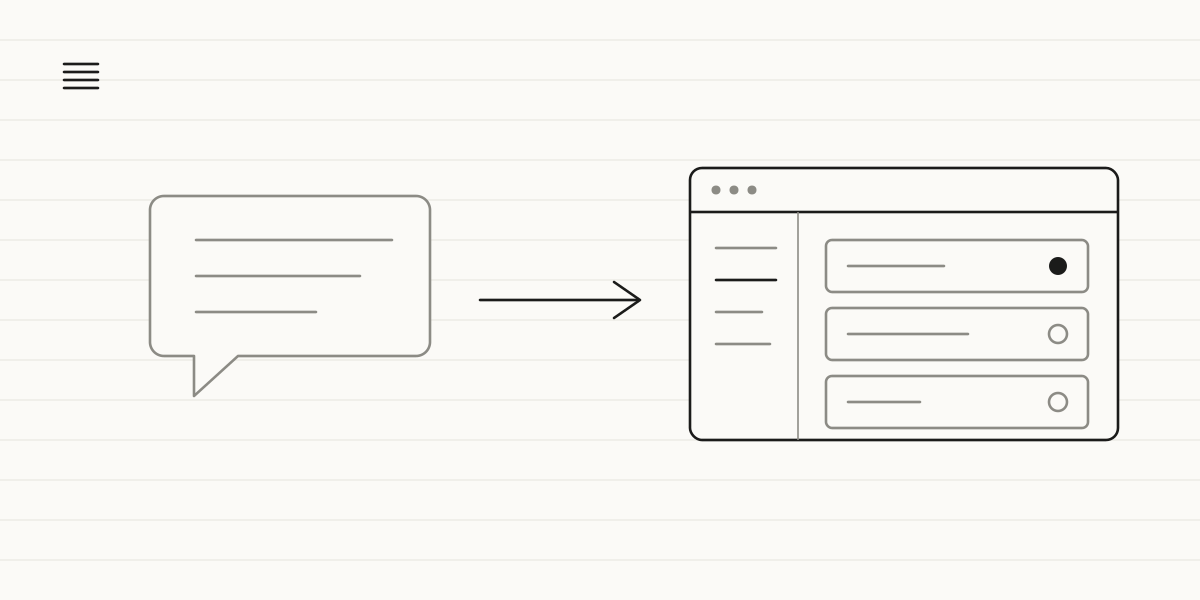
Vibe coding is creating software by describing in plain language what you need, instead of writing it in code: you explain the process in your own words and the AI builds the application. Put briefly: you tell the machine how you work and the machine hands you back the tool.
A down-to-earth example. Instead of a forty-page requirements document, you write something like: "I need a screen showing every pending quote, that warns me when one has gone ten days without a reply and that, when I accept it, generates the job sheet with the materials to order". That, which three years ago was the starting point of a six-month project, can today be a prototype you see running the same afternoon.
From months to weeks, from enterprise budgets to SMB cost
The practical consequence is twofold. First, timing: you go from month-long projects to first versions running in weeks, so you can test the tool with real cases from your business before spending the whole budget. Second, price: when development hours fall, custom software stops being an enterprise investment and lands in the range an SMB would consider for any other operational improvement.
At Zen Praxis we work within that frame: a first solution running in weeks, a fixed budget from the start, and the potential to recover up to 35 hours a month per person, with the investment paid back in under six months. Those are potential figures, not a guarantee: they depend on how much time the process you're replacing is costing you today. That's why the first step is always to measure it.
Off-the-shelf or custom? The 90 % rule
Affordable doesn't mean advisable. The rule we use is simple: if off-the-shelf software covers 90 % of your process, use it. A product used by thousands of businesses is better tested, updates itself, has support and doesn't depend on any one person. Swapping it for something of your own just to cover the missing 10 % almost never pays off, least of all if your process is the standard one in your sector: invoicing, stock control, bookkeeping, managing a calendar. There, off-the-shelf is the right answer.
Custom comes in when that 90 % isn't met. And there are five signs that, in our experience, give it away better than any analysis.
1. The process that sets you apart is exactly the one no program understands. What you do differently, and what your customers choose you for, happens to be what fits into no software on the market.
2. Chronic double entry. The same thing written in two places, every day, because the tools don't talk to each other.
3. Recurring manual reports. Every month someone on your team spends a morning assembling the same report by hand, exporting from here and pasting there.
4. Underused licences that add up. You pay per user and per module for a product you use three features of, and the annual total is starting to look a lot like what something built for you would cost.
5. Impossible integrations. You need two programs to share information and the vendor's answer always ends up the same: that isn't supported.
With a single sign, probably not. With three or more, every month that passes you're paying the workaround tax in your team's hours.
| Your situation | Off-the-shelf software | Custom tool |
|---|---|---|
| Your process is standard for the sector | Yes: it covers 90 % | Unnecessary |
| You need to start next week | Sign up and it works | Weeks in between |
| Your process is what sets you apart | Always falls short | Fits by design |
| You record the same thing twice | Forces double entry | A single record |
| You pay for licences you barely use | Fixed cost per user per month | Upfront build plus maintenance |
| The business changes every year | You depend on their roadmap | Changes when you need it to |
A real case: Odonis, clinic and lab on the same case
The clearest example we have is Odonis. The starting problem was very specific and very familiar in the dental sector: coordination between a clinic and its prosthetics lab travels over WhatsApp, email and phone calls. The prescription is written in a message, files are sent with links that expire after seven days, and the status of each job is checked by picking up the phone: "did you get it?", "when will it be ready?".
No generic clinic management software solved that, because the process lives right on the border between two different businesses. The tool was built around that process: a structured prescription instead of a free-form message, files that don't expire, real-time case status for both sides, and GDPR-compliant traceability. What began as a custom tool for one concrete problem ended up as a sector product.
That's the shape a good custom software case usually has: it isn't "we want our own ERP", it's an identifiable bottleneck that costs you hours every week and that no product on the market touches. If your business is a clinic, in AI for clinics we break down the processes where that bottleneck usually sits.
The limits of do-it-yourself
At this point it's worth being honest, because the enthusiasm around vibe coding tends to skip this part. AI writing the code doesn't mean nothing needs to be known any more. It means the work has moved: from typing code to deciding well what gets built and keeping it alive afterwards.
A prototype built in an afternoon is exactly that, a prototype: it's for finding out whether the idea works, not for your business to depend on. Between that prototype and a tool your company lives off there are four things nobody will hand you for free. Well-structured data, because a pretty tool on badly built data forces you to redo it within a year. Security and data protection, especially if you're going to store customer information or health data. Maintenance, because software is never finished: an integration changes, a regulation changes, your process changes. And team adoption, which is where most projects stall halfway: a tool nobody uses saves nobody an hour.
That's why our process is always the same. A free diagnosis to understand which process is costing you the most hours and whether you genuinely need something custom —often the honest answer is that you don't—. A proposal with a fixed budget and timeline, no surprises halfway through. Implementation without stopping your operation. And support afterwards, with training for the team. It's what we call the Zen Praxis Method, and the order matters: the technology is the easy part.
Where to start
Before asking anyone for a quote, measure. Pick the process you handle worst and write down how many hours a month your team loses to it —the parallel spreadsheet, the double entry, the manual report—. That number is what decides whether custom pays off, and it will also be your proof that it worked. If you're still far from needing anything of your own, start with the list of 5 tasks you can automate this week; and if what you're missing is the wider context, we cover it in why AI matters for your business today.
How many of the five signs does your business have right now? Book a free 30-minute call and we'll tell you whether your own tool pays off or whether what you already have is enough, no jargon and no strings attached.