
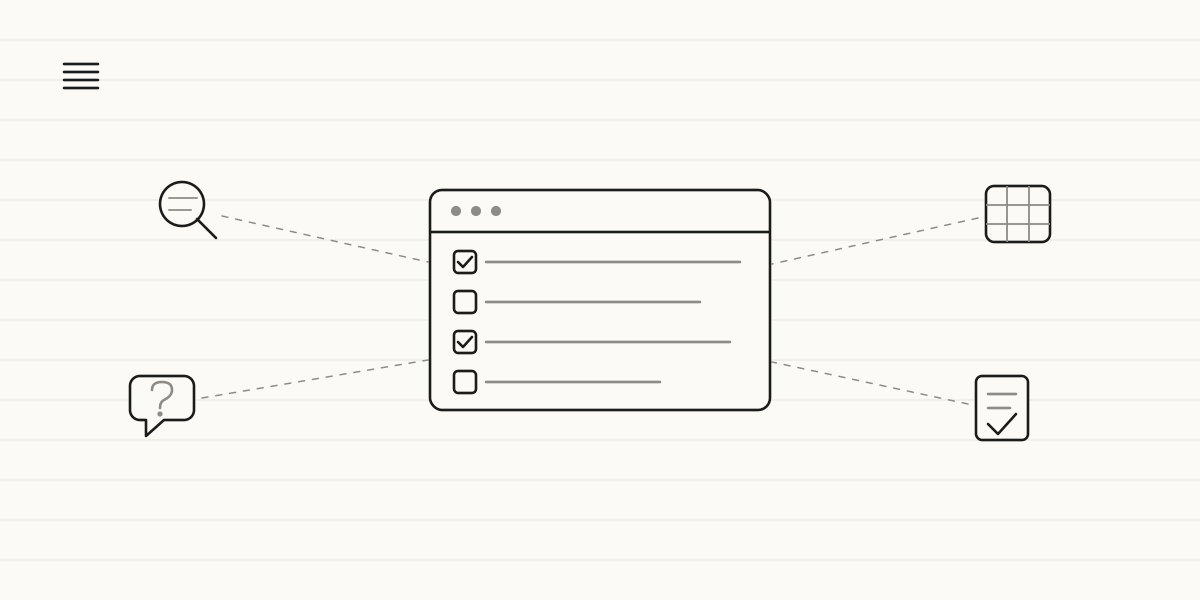
Before you sign with an AI vendor, your SMB needs a clear answer to six questions: which exact process it solves, what data it uses, how much it costs with a fixed budget, how long it takes to go live, who trains your team, and what happens if it doesn't deliver. Without those answers in writing, you're the one carrying the risk.
Getting a proposal like this is becoming more common: according to a survey by IONOS and YouGov of Spanish SMB decision-makers, 35 % planned to invest in artificial intelligence this year. But investing isn't the same as getting it right. You'll receive a document written in language you don't speak fluently, a price you can't tell is fair, and a promise of results nobody has put in writing in a measurable way.
Real adoption in Spain is still a minority, so there aren't many nearby examples to lean on. According to the survey on ICT use and e-commerce in companies that Spain's National Statistics Institute (INE) published on 22 October 2026, with data from the first quarter of 2026, 33.6 % of Spanish companies with 10 or more employees use artificial intelligence, falling to 21.4 % among those with fewer than 10. Most people weighing up hiring a vendor right now are doing it without a fellow business owner down the street to ask how it went. The checklist below is that reference point.
Which exact process are you going to automate?
Be wary of a vendor who only talks about "artificial intelligence" in the abstract and can't name the exact task that's going to change in your business. A serious proposal says something like "we're going to automate replies to the fifteen questions your customers ask most on WhatsApp" or "we're going to connect your invoicing software with your CRM so you stop copying data by hand." If the first meeting doesn't produce a named, specific process, there's no project yet — just a sales pitch with the word AI in front of it.
Ask them to walk you through the process your team follows today: who does it, how long it takes, what happens if it goes wrong. If the vendor can't describe your current process, they can't promise to improve it either. It's the same logic we cover in how to go from AI experiments to real results: a project starts with a concrete problem, not a trendy technology.
What data does the tool use, and who owns that data?
Every AI solution needs data to run: your customers' details, your prices, your order history, your invoices. Before you sign, ask exactly what data the tool will use, where it will be stored, and what happens to it if you ever stop working with that vendor. The answer has to be specific: what information leaves your business, where it goes, and who can access it.
A serious vendor tells you plainly that the data is yours and that you can export it whenever you want. If the answer is vague — "we'll figure that out later," "don't worry about it" — that's a sign they haven't thought it through themselves, and you're the one who'll inherit that oversight the day you want to switch providers or end the contract.
What does it really cost, and is the budget fixed or open-ended?
The question that saves the most money is the most awkward one to ask: is this a fixed price, or an estimate that can grow along the way? An open-ended budget — "it depends how it goes," "we bill by the hour as needed" — shifts all the project's risk onto you. A fixed budget forces the vendor to have thought through the entire project before they start charging for it.
Also ask the price to make clear what happens after delivery: whether maintenance, adjustments, and the first month's support hours are included, or a separate cost that shows up thirty days later. It's the same point we make about custom software for SMBs: AI has lowered the cost of building your own tools, but that only turns into a real saving if the budget is fixed from day one.
How long until the first solution is up and running?
An AI project for an SMB shouldn't take six months or a year to produce a usable first result: the technology is at a point where the first working piece can be ready in weeks. If the vendor only talks about phases, milestones, and a quarter-by-quarter timeline with no interim delivery you can actually use, ask why nothing comes sooner.
Insist on a firm date, not a vague promise of "soon." And ask what counts as "live": an internal demo, or something your team is already using with real customers. Those are two very different things, and only the second one counts.
Who trains your team to use it every day?
The most sophisticated tool is worthless if nobody knows how to use it on Monday, or if only the person who sat in on the demo understands it. Ask who trains your team, how long that training takes, and what happens if someone new joins in three months who wasn't there: is there material they can go back to, or does it depend on someone explaining it from memory?
This isn't a minor detail. It's actually the same risk we cover in your team is already using AI (and you probably don't know it): tools nobody has properly explained end up being used badly, or not used at all — which is the most expensive way there is to have paid for something.
What happens if the solution doesn't deliver the expected result?
It's the question almost nobody asks before signing, and the one people most regret not asking afterward. An AI project without a clear business goal from the start — how many hours it has to free up, which process needs to stop being done by hand — is a project you can't evaluate, and what you can't evaluate you can't fix. MIT Media Lab, in its report "The GenAI Divide: State of AI in Business" (2025), studied generative-AI pilot projects at large companies and found that 95 % never produced a measurable financial return. That figure comes from large companies, not SMBs, and the study doesn't put it down to a lack of goals. But it shows how easy it is to pay for a pilot that leaves nothing behind, which is why the measurable goal gets set before signing, not after.
Ask what the project's success will be measured against — hours saved, inquiries resolved without human intervention, response time — and what happens if that number hasn't moved after three months. A vendor who trusts their own work has no problem putting this in writing.
Red flags to watch for when talking to an AI vendor
| Question | A serious vendor's answer | Red flag |
|---|---|---|
| Which process will you automate? | Names the exact task and who does it in your business today | Talks about AI in general without mentioning your process |
| What's the final price? | A fixed number, with what's included and what isn't | "It depends," billed hourly, nothing in writing |
| How long until the first delivery? | A specific date and what you'll be able to use on that day | Only phase timelines with no interim delivery |
| Who trains my team? | Says who, for how long, and what material stays for people who join later | A demo on day one and nothing after |
| What happens to my data? | States plainly that it's yours and how you export it | "We'll figure that out later," or they don't know |
| How do you measure if it works? | Proposes a specific number: hours, inquiries, response time | No way to know whether the project achieved anything |
These six questions are, without our having planned it that way, the same order we follow at Zen Praxis: a free 30-minute call to pin down the exact process costing you the most hours, a proposal with a fixed budget before we touch anything, implementation — usually integrating the tools you already use, or building a custom tool when there's nothing to connect — and hands-on support so your team masters what we've built. It's not the only right way to work, but any serious vendor should be able to answer these same questions without hesitating.
If you already have a proposal on the table and you're not sure whether asking these questions would change anything, book a free 30-minute call: we'll tell you which process is worth automating first and what you should demand in writing before you sign with anyone.