
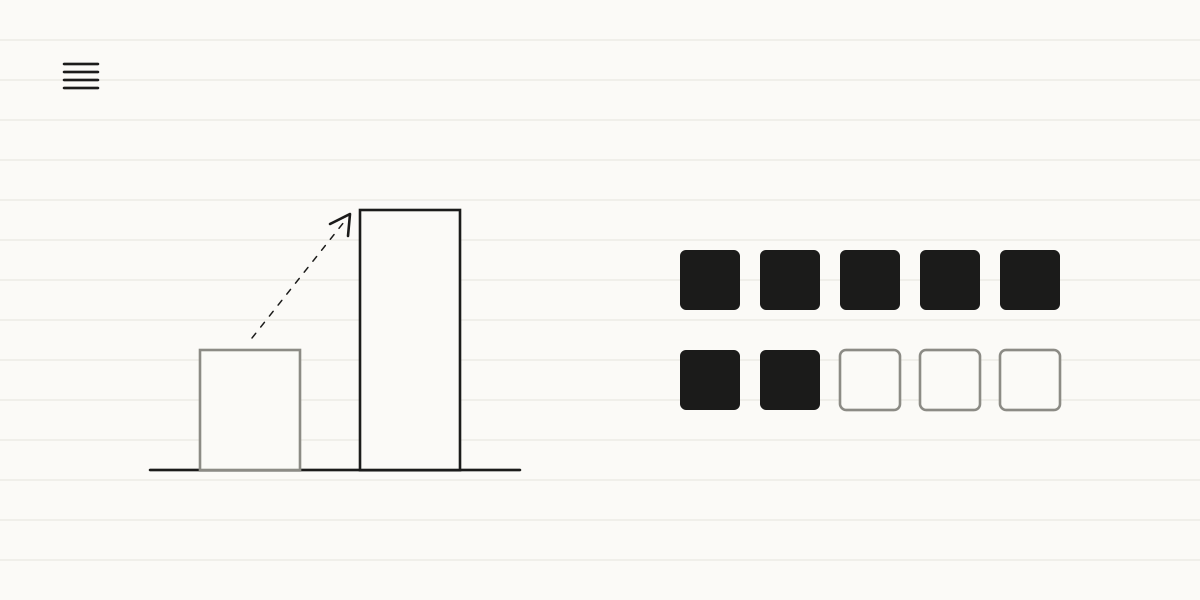
According to Wolters Kluwer's 2026 Accountancy Barometer, 71 % of advisers in Spain already use artificial intelligence in their daily work, up from 42 % in 2025. They apply it mainly to bookkeeping, tax and document management, and 84 % say it frees them from repetitive tasks so they can spend the time advising.
If there's one cautious sector by definition, it's professional practices: the work is numbers, deadlines and responsibility over other people's paperwork, so nobody here tries things out of curiosity. That's why this year's figure reads differently from any other AI adoption statistic. When the deadlines sector moves as a block in twelve months, it has stopped being a bet.
The figure: AI stops being a curiosity in Spanish firms
Going from 42 % to 71 % in a year is 29 points more: AI use in practices has almost doubled. That isn't a slow trend: it's the year AI use in accountancy went from early adopters to normal. And it's worth looking at who makes up that percentage, because that's the interesting part: 77 % of Spanish firms have fewer than 10 employees. We're not talking about practices with an innovation department, we're talking about businesses the size of yours.
| 2026 Accountancy Barometer (Wolters Kluwer) | Figure |
|---|---|
| Advisers using AI in their daily work | 71 % (42 % in 2025) |
| Say technology frees them from repetitive tasks | 84 % |
| Increased their billing in 2025 | 67 % |
| Grew their client base | 69 % |
| Point to lack of in-house experience and training as the barrier | 53 % |
| Firms with fewer than 10 employees | 77 % |
There's one more figure, and it's aimed at whoever runs a small business rather than a practice: advisers who saw their clients as having a low level of digitalisation have gone from 39 % to 22 % in a year. In other words, it isn't only your accountant who's moving. It's also the businesses sitting across the table from them.
What the firms ahead of the curve are automating
Bookkeeping and invoices: from typing to reviewing. It's almost everyone's entry point, and for good reason: automatic capture and classification of invoices attacks the task that eats the most hours and requires the least professional judgement. The document arrives, it's read automatically, the entry is proposed, and the adviser reviews and approves. The work doesn't disappear; it changes in nature.
Document management and search. The second source of invisible hours in a practice is finding things: last year's filing, the contract that client sent over, the deed that was in an email eight months ago. A search that understands what you're asking of your own archive turns a twenty-minute task with two phone calls into a twenty-second one.
Client support: the same twenty questions, answered on their own. "What documents do you need from me?", "when is this due?", "did what I sent arrive properly?". They're legitimate, repeated queries that interrupt in exactly the worst week of the quarter. An assistant trained on the firm's own information resolves most of them instantly and passes anything with nuance to a person. For the process-by-process detail, we break it down in AI for accounting firms: 5 processes you can automate this month.
Why they moved so fast (hint: it isn't fashion)
84 % say technology frees them from repetitive tasks, and that sentence explains the rest of the numbers: 67 % increased billing and 69 % grew their client base last year. The chain is simple and holds for any service business: the hours not spent typing get spent advising, and advising is exactly what clients value, recommend and pay for. Automating the mechanical part doesn't hollow out the work of a firm; it gives back the part it exists for.
There's also an effect that rarely gets mentioned: it changes the conversation with the client. When document intake and repeated queries resolve themselves, the adviser stops chasing paperwork and starts anticipating. And an adviser who anticipates doesn't get swapped for one twenty euros cheaper.
The real barrier isn't money: it's knowing where to start
The barometer itself says so: 53 % point to a lack of in-house experience and training as the main brake. Price doesn't come up. Technology doesn't come up. Not knowing where the door is does. And that matches what we see: the usual mistake isn't picking the wrong tool, it's starting by buying a tool instead of choosing a process.
Automating a practice isn't buying a program with AI in it: it's choosing the process that steals the most hours, solving it in a measurable way, and training the team to use it without fear. That's the order of the Zen Praxis Method —diagnosis, proposal with fixed timelines and budget, implementation and support— and it's also what makes training useful: not a generic AI course, but teaching the team on the real case already running on their desk.
If you run a business rather than a practice, this concerns you too
What your accountant does with invoices, you can do with your orders, your appointments or your quotes: it's the same mechanics —documents coming in, data being copied, questions repeating— applied to your business. And low digitalisation falling from 39 % to 22 % says your competitors are already on it.
The first step isn't technological either: it's having your data in one place and in decent shape, which is what we talk about in from scattered spreadsheets to clear decisions. With that sorted, the potential of this kind of automation is freeing up to 35 hours a month per person, with the first solution running in weeks and the investment recovered in under six months.
And there's a bigger leap than automating isolated tasks: putting in order the entire flow between two parties who pass work back and forth all day —the firm and its client— so documentation arrives properly from the start and the status of every filing is visible to both without anyone having to ask. That's no longer automating a task, it's a tailored tool; and it's what separates a practice that answers quickly from one you don't need to write to.
What to do if you're in the remaining 29 %
The advantage of arriving now is that there's no need to explore blind: the sector has done the fieldwork for you. You know where everyone else came in, you know the barrier is method rather than budget, and you have the detail of what gets automated in each case in AI for accounting firms: 5 processes you can automate this month. What doesn't pay off is waiting for next year's barometer to look at the figure from the outside again.
Spain's most cautious sector has already taken the step, and it took it from practices of fewer than ten people. The question is no longer whether AI is for you, but which process you automate first. Want to know which one that is in your case, whether you run a practice or any other business with paperwork? Book a free 30-minute call: no jargon and no strings attached.